Support



A cryptocurrency transfer can technically go through successfully, but the funds still may not immediately become available to the recipient. Sometimes the reason is asset verification based on AML criteria, when the system detects a link to undesirable sources or a suspicious transaction history. It is especially important to take this into account before exchanging a large amount or accepting USDT from an unknown counterparty. The Obmify exchanger monitoring service helps compare the terms of different services, but the AML requirements of a particular platform need to be studied before making a transfer.

What is AML blocking of cryptocurrency?
AML is short for Anti Money Laundering, that is, a set of procedures aimed at countering money laundering and other illegal financial operations. In the cryptocurrency sphere, this is done by analyzing the history of asset movements on the blockchain, the connections between addresses, and other factors that may indicate an increased level of risk. Blocking occurs when a service temporarily restricts access to assets or suspends a transaction until the circumstances are clarified. This does not necessarily mean that the owner of the funds has broken the law: an automatic check may react to the previous history of the asset, even if the current user was not involved in the problematic activity.
For example, a person received USDT as payment and then decided to exchange cryptocurrency. If part of the assets previously passed through a high-risk address, the chosen service may suspend the transaction and request additional information. AML should not be confused with KYC. KYC mainly concerns client identification, while KYT is used to analyze transactions and asset movements. In practice, these procedures can be applied together, especially when financial monitoring of significant or unusual transfers is carried out.
Why can cryptocurrency be blocked due to AML?
The main reason is not the cryptocurrency itself, but its history and the connections revealed during checks. Every public transaction leaves a record in the corresponding ledger, so specialized analytical systems can examine previous movements of assets between addresses. Increased attention may be drawn to connections with categories that a specific provider assesses as high-risk. These can include sanctions, stolen assets, known fraud, scams, as well as the use of services like mixers designed to complicate tracking of coin movements. At the same time, not every indirect contact with such an address automatically means blocking. Different platforms use their own rules, thresholds, and assessment models. Factors that may be taken into account include the distance to the source of risk, the share of problematic assets, the transaction amount, and other characteristics.
The origin of funds has particular significance, because if a service requests confirmation, the user may need information about the previous transaction, the history of asset acquisition, or other documents depending on the rules of the specific platform. This is why checking the conditions before making a transfer is much easier than resolving the issue after the transaction has been stopped.

What does AML risk mean?
AML risk is an assessment of how much the history of a particular asset or address is connected with categories that the analytical system considers undesirable or requiring additional attention. It is not a universal indicator: the methodology and acceptable risk limit may differ depending on the service. For USDT and other assets, an analysis of previous movements between addresses may be carried out. If a significant portion of the funds is associated with high-risk sources, further crypto exchange may require additional procedures. It is important to distinguish between direct and indirect connections. If funds came directly from a known problematic address, that is one situation; if contact occurred through a long chain of intermediate transfers, that is another. Therefore, a risk label alone without an explanation of its structure does not provide a complete picture. Before a large transfer, a check allows you to see a potential problem earlier than the moment when the asset is sent to the deposit address. This is especially relevant if USDT was received through P2P, from third-party counterparties, or from several unknown sources.
How to check cryptocurrency before exchanging?
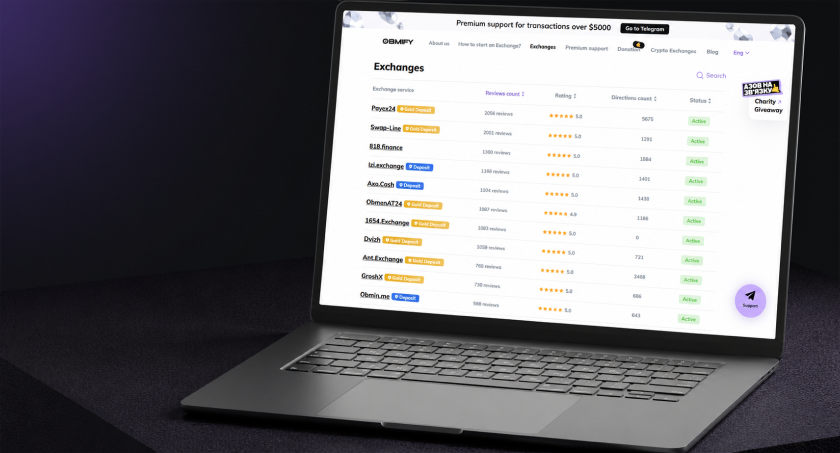
Before sending funds, you need to check not only the rates but also the rules of the service through which the exchange is planned. Obmify, as a monitoring service, helps to compare exchangers by directions and available conditions, after which the user can familiarize themselves in more detail with the requirements of a particular provider.
A practical procedure may look like this:
- check which AML policy the selected exchanger uses and under what conditions additional verification is possible;
- make sure that the sending network corresponds to the network specified for the deposit, especially when transferring USDT;
- before a significant transaction, conduct AML assessment of your wallet address or assets through an appropriate analytical service;
- save the TXID, data of previous transfers, and other information that may be needed to confirm the history of the assets;
- clarify the rules regarding KYC, AML, and the procedure if transaction verification reveals an increased level of risk.
If funds are stored in a personal crypto wallet, it is useful to know from which sources they came. When a wallet is used for numerous deposits from unknown persons, tracking the history of individual assets can be more difficult. On Obmify, you should pay attention not only to the rate, but also to the available information about the service and its rating. At the same time, the very fact that a platform is present in the comparison system does not cancel the need to independently familiarize yourself with its rules before making a transfer.
How to avoid AML blocking of cryptocurrency?
It is impossible to completely eliminate the risk, but it can be reduced if you control the sources of incoming funds and do not make large transfers without prior analysis. Verification of assets received from unknown counterparties must be particularly thorough. If you buy USDT through a third-party platform or receive it as payment, you should keep information that explains the origin of the funds. For regular operations, it is useful not to mix, without necessity, assets from a large number of unknown sources in one wallet. Before starting an exchange, check the AML rules of the selected service and the conditions for undergoing additional identification. If the platform explicitly describes the procedure for working with high-risk assets, it is better to read these rules before sending funds. Technical verification of the payment details is also important, because even if the AML indicators do not raise any questions, the wrong network or an error in the address creates a completely different problem that is not directly related to AML.
What to do if cryptocurrency has already been frozen?
If a freeze has occurred, the first thing to do is to determine its exact reason from the service that suspended the operation. You should not try to bypass the procedure by creating new accounts, splitting amounts, or complicating further transfers, as such actions may only make the situation worse. Usually, the user needs to contact customer support and obtain a list of information required for case review. This may include TXID, data on the source of the assets, confirmation of a previous transaction, and other materials in accordance with the policy of the specific service.
If USDT came from an exchange, P2P platform, or another service, it is worth collecting the available transaction history. The more accurately you can explain the path of the assets, the easier it is to go through the review procedure, although this does not guarantee automatic unfreezing. Reverification may take varying amounts of time, so there is no universal timeframe. If the freeze is related to legal requirements, sanctions restrictions, or a request from competent authorities, the procedure for resolving the issue may be more complex than standard internal AML control.
Can cryptocurrency be returned after AML blocking?
The possibility of return depends on the reason, the service’s rules, and the outcome of the review of the specific situation. The blocking itself does not always mean the final loss of assets: in some cases, access can be restored after providing the necessary information and completing the procedures. At the same time, one cannot proceed from the assumption that any crypto asset will necessarily be returned. If a connection with illegal activity is established, sanctions restrictions apply, or the funds are the subject of an official investigation, the decision may depend not only on the platform’s internal rules. Therefore, after blocking, you should act through the official support channel, keep all correspondence, and provide only accurate information. If the amount is significant or the situation has a legal nature, consulting a specialized lawyer in the relevant jurisdiction may be advisable.
The best strategy remains preventive: checking assets, having a clear history of funds’ origin, and carefully choosing a service before the transaction reduce the likelihood of unforeseen problems. Through Obmify you can monitor available exchange services before making an exchange, and AML and KYC conditions should be additionally clarified with the chosen provider.