Support



Cryptocurrency today is a full-fledged financial resource used by exchanges, exchangers, bots, and various services. However, along with convenience, additional rules have appeared, and ignorance of them can lead to the loss of funds (cryptocurrency). One of these rules is the use of memo when making transfers, especially in the TON network. Understanding how this mechanism works directly affects the correctness of any transaction and the security of the user’s funds.
What is the Memo tag in simple terms?
Memo is a special code or identifier that is added to a transfer and indicates the purpose of the payment. Simply put, it is an additional tag that helps the system understand which specific account or user the sent funds belong to. In blockchain systems where one address can be used by many clients at the same time (for example, on an exchange or in an exchange service), the memo tag becomes a mandatory element. Without it, the platform cannot automatically identify the recipient, even if the transaction itself is successfully confirmed on the blockchain. Thus, memo is not a comment or an optional feature, but a key element of payment purpose that ensures the correct transfer of cryptocurrency.
Why is Memo needed for TON transactions?
In the TON network, deposits to shared addresses are actively used. One platform or exchange may have only one address for receiving cryptocurrency, while the distribution takes place within the system. This is where the memo tag plays a decisive role. When a user makes a TON transfer, the system reads not only the recipient’s address but also the purpose encoded in the memo. This allows the algorithm to automatically credit the cryptocurrency to the correct account without operator involvement.
If the memo is missing, the transaction is technically considered completed, but the crediting does not occur. The funds “hang” on the service’s shared balance, and further processing requires manual intervention.

Features of using the memo tag in the TON network
The main feature of TON lies in its high speed and automation. Most operations here rely on an automatic recognition process. The memo tag is used as the main tool for user identification. It is important to understand that memo is generated individually for each deposit. It cannot be invented manually or reused. Before sending, you must accurately copy the specified code; otherwise, the payment purpose will be lost. The advantage of this approach is a high level of security and minimization of errors on the service side. Among the disadvantages is the high level of responsibility placed on the user when entering data.

What happens if you don’t enter Memo?
If you send TON without a memo in a situation where it is required, the transaction will go through, but the funds will not be credited automatically. The user’s balance will not change, and the cryptocurrency will end up in the service’s shared wallet.
In this case, contacting support is required. As a rule, services request video confirmation according to a standard instruction:
- Show login to the wallet or platform from the desktop;
- Show login to the wallet or platform from the desktop;
- Open the transaction history;
- Select the required transaction and show the details;
- Refresh the page;
- Go to the link in the blockchain explorer;
- Refresh the explorer page;
- Show the exchange request;
- Provide the transaction hash in text form.
- Provide the transaction hash in text form
If the request is approved, the cryptocurrency is returned automatically to the original wallet (for example, Tonkeeper). When transferring from an exchange, an additional request to the exchange’s support team will be required.
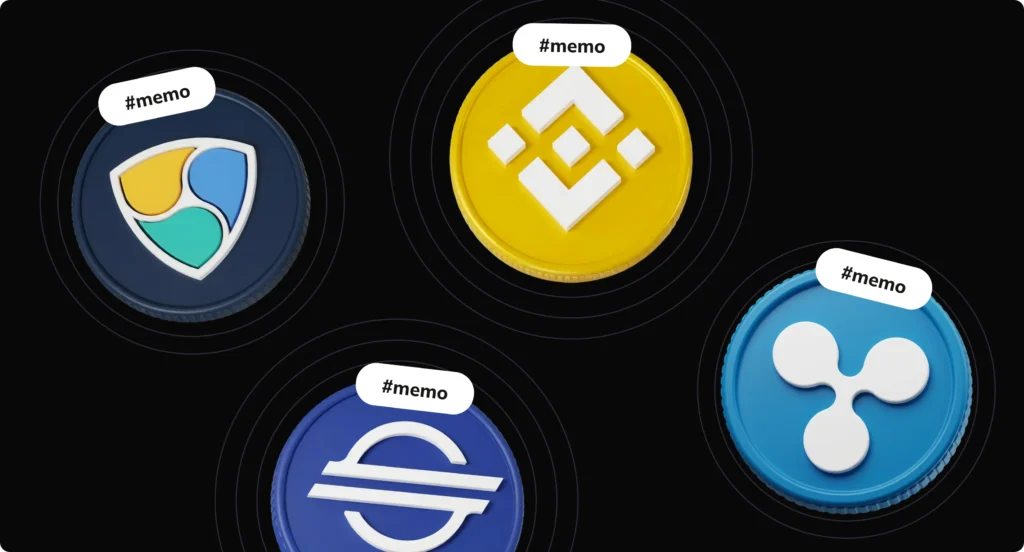
The importance of the memo tag for correct cryptocurrency transactions
The memo tag ensures correct accounting of cryptocurrency, reduces the risk of errors, and speeds up payment processing. It allows cryptocurrency acceptance to be decentralized while maintaining accurate identification. Without memo, the system cannot guarantee the correct assignment of funds, even if the transaction itself was successful. Therefore, this tag is not a formality, but a guarantee of the correct operation of the entire system and the procedure of transferring cryptocurrency independently.
What other cryptocurrencies use the Memo destination tag?
- XRP (XRP Ledger). In the XRP system, instead of the word memo, the term Destination Tag is more often used. Essentially, it is the same tag indicating the purpose of the payment. In practice, it is especially important when transferring to exchanges and large platforms that accept deposits to a single shared address and then distribute funds among internal accounts. How it works:
- The exchange has one recipient address (or a limited number of them).
- The Destination Tag acts as a user/account identifier within the exchange.
After the transaction is confirmed, the exchange reads the tag and credits the funds to the correct balance.
An important nuance: some services can restore a deposit manually, but this depends on internal rules, support workload, and specific conditions. Therefore, for XRP, the Destination Tag is not an “option” but a practical necessity when transferring to services with shared addresses
- XLM (Stellar). In the Stellar network, a similar mechanism is used — Memo (Text/ID/Hash/Return). It performs the same task: it indicates the purpose of the payment and serves as a key for internal fund distribution when a service accepts deposits to one shared address. Why XLM often requires Memo:
- exchanges and exchange services widely use a single deposit address;
- Memo becomes a marker tag of a specific user;
- without it, the system will not be able to recognize whose payment it is, even if the transaction is confirmed.
In Stellar, Memo can have different formats (text, numeric ID, hash). Therefore, it is important to copy it strictly in the form specified by the service; otherwise, the purpose will be considered incorrect.
- BNB (Binance Coin). For BNB, the need for a tag depends on which network the transfer is made on and where exactly you are sending the cryptocurrency. Most often, a “tag” (Memo/Tag) is required when depositing to exchanges and services that use a shared address. The typical logic is the same: the address is shared — the tag defines the purpose — the system performs automatic crediting. Where the tag requirement is most often encountered:
- requirement is most often encountered:
- when depositing BNB to exchange addresses;
- when making transfers within services where one address has many users.
Practical conclusion: if, when depositing BNB, the recipient side specifies a Memo/Tag field, it is a mandatory detail. Sending without it may lead to manual verification and delays in recovery.
- XEM (NEM). In the NEM network, instead of Memo, Message/Payment ID is used (depending on the service interface). In essence, this is also a destination tag that helps services automatically distribute incoming funds to a shared address. Why this is important:
- exchanges and exchangers often use one address for deposits;
- an internal identifier is needed to identify the user;
- without it, funds arrive “without an owner” from the service’s point of view.
In general, cryptocurrency users should remember that Memo is not a formality and not an additional field “just for show”, but a key identifier on which the logic of modern cryptocurrency transfers is built. It is this tag that allows exchange, exchanger, and service systems to accurately determine the purpose of a payment, perform automatic crediting, and link a transaction to a specific user account. This is especially critical for transfers in the TON network, where the level of automation is very high.
Any mistake or absence of the memo tag does not block the transfer itself on the blockchain, but breaks the recognition chain within the service. As a result, cryptocurrency can remain “stuck” in the system for a long time and require a complex confirmation procedure through support. Therefore, before every cryptocurrency transfer, it is important not only to copy the address, but also to carefully check all details, including the destination tag, and strictly follow the platform’s instructions.