Support


Exchanging cryptocurrencies takes only a few minutes, but even one mistake can lead to loss of funds or delay of the transaction. Most often, problems arise not because of the exchanger or blockchain, but because of incorrectly filled in details, inattention or ignorance of the rules of a particular service. Let’s consider the most common situations and ways to avoid them.
Why do most exchange problems occur?
The vast majority of support requests are related to the human factor. The client may choose the wrong network, make a mistake when copying the wallet address, not specify Memo, or not familiarize himself with the exchanger’s rules. Unlike bank payments, most blockchain transactions cannot be canceled after confirmation. Therefore, before sending a transfer, it is worth checking all the details again.
TOP of the most common problems to consider
An incorrectly specified wallet is the most common cause of loss of funds
Incorrectly entered wallet address remains the main cause of loss of funds. The error may occur due to:
- randomly changed character;
- using the old address;
- choosing an inappropriate cryptocurrency wallet;
- incorrect network;
- copying details from the previous application.
Always copy the wallet address from the current application only. Some services create a new address for each exchange, so using old details can lead to delays or loss of funds.
Before confirming the transfer, check:
- the first and last 5-6 characters of the wallet address;
- the name of the coin;
- the network specified in the application.
You should be especially careful when exchanging USDT. This coin works on different networks, so USDT in TRC20, ERC20 or BEP20 are different ways of transferring the same asset. If the network does not match the details of the exchanger, automatic crediting may not occur. Binance, Bybit, OKX and Trust Wallet work similarly. In these services, one cryptocurrency can also support multiple networks, so the check only takes a few seconds, but helps to avoid costly mistakes.
When should you make a test transaction?
A test transaction is not mandatory, but it is recommended to perform it if:
- the exchange amount is large;
- you are using a new exchanger;
- this is the first transfer to a new cryptocurrency wallet;
- the operation is carried out through a new exchange.
Send a small amount first, wait for confirmation, and only then transfer the main funds.
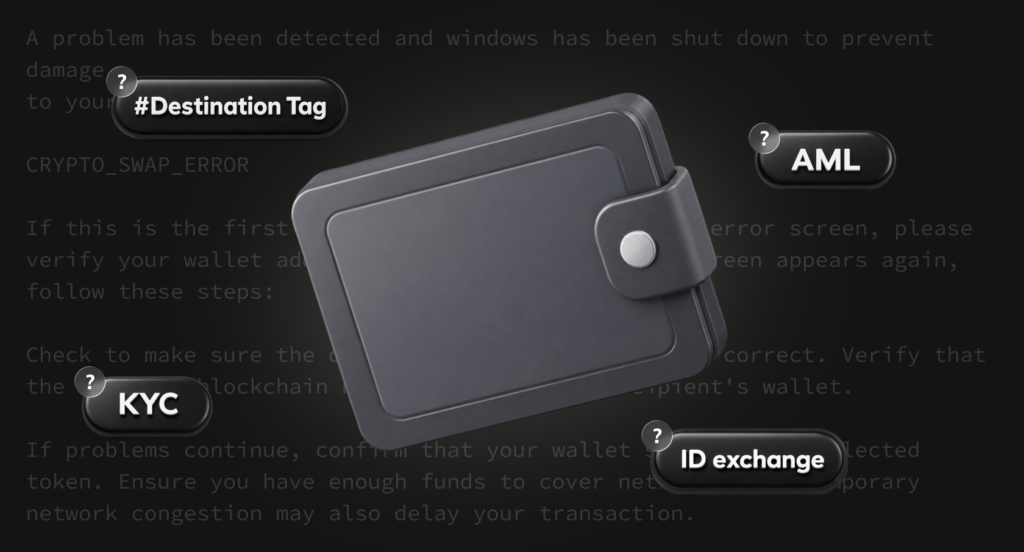
Memo (Destination Tag) – a small field that can lead to loss of funds
Memo or Destination Tag is an additional identifier that helps the exchanger identify the recipient of the transaction. Most often, users encounter it when working with TON. If Memo is specified in the application, it must be specified. Even a correctly entered wallet address does not guarantee automatic crediting without this field.
If Memo is missing, you do not need to invent it yourself.
If in doubt:
- contact support;
- clarify whether Memo is needed;
- if specialists have confirmed that it is not used, perform the transfer without it.
AML check – why it must be passed BEFORE sending funds
AML (Anti-Money Laundering) is an analysis system that checks the origin of a crypto asset and assesses possible risks. The check takes into account transaction history, interaction with risky addresses, sanction lists and other factors. The results form an AML Risk Score.
It is important to conduct a risk check before creating a transfer. After sending the funds, they already interact with the exchanger’s address, so the analysis results may change. Therefore, it is too late to check the asset after the transaction. You should not rely only on third-party AML services, because they use their own evaluation algorithms, so the results may differ from the exchanger’s own check. The best solution is to contact the support service before creating an application, provide the wallet address and ask for a risk check. This will allow you to assess possible restrictions in advance.
Exchange ID – information that will help you quickly solve the problem
After creating a request, each exchange is assigned a unique ID, because the support service finds information about the transaction by it. If there is a problem, do not create a new request, it is better to contact the support service, provide the exchange ID and, if possible, add the transaction hash. This will significantly speed up the verification. If the exchanger does not respond for a long time or does not help to resolve the issue, you can contact the Obmify support service.
Paid refunds: why it is important to read the AML/KYC policy before exchanging
Before creating an application, open the AML/KYC policy section on the page of a specific exchanger. It is there that it is indicated what happens if the crypto asset does not pass verification or the transaction requires additional confirmation. Pay special attention to the refund conditions. They can differ significantly:
- some services refund funds without additional payment;
- others charge a fixed fee;
- sometimes a certain percentage of the exchange amount is charged;
- a network fee for the return transfer may be taken into account separately.
If the refund is free, this is usually directly stated in the policy. If it is paid, the service must indicate a fixed amount or percentage. You should not be guided by the terms of another service, since each exchanger sets its own rules.
Check the AML/KYC policy before each transaction, even if you have used this service before. Rules, limits and commission rates may change. If the client assumes that his crypto asset may not pass the AML check, it is better not to create an application right away. First, it is worth contacting the support service, providing the wallet address and clarifying possible risks, the verification procedure and refund conditions.
How to avoid most problems?
Before each exchange, it is enough to perform a few simple actions:
- check the wallet address, coin and network;
- use details only from the current application;
- do not skip Memo, if it is specified;
- conduct a risk check before sending the asset;
- save the exchange ID and transaction hash;
- read the AML/KYC policy in advance;
- for a large amount, first make a test transfer.
Most cryptocurrency exchange problems can be prevented before the send button is pressed. Careful checking of details, understanding the rules of a specific service and timely contacting the support service help to save money, avoid delays and exchange without unnecessary risks.